

One of the most debated topics in natural stone installation is joint spacing.
Should stone be laid with:
- ultra-tight minimal joints,
or - more open traditional joints?
The answer is not as simple as choosing whichever looks more modern.
Because grout joints are not only aesthetic, they also influence:
- movement,
- drainage,
- installation tolerances,
- long-term durability,
- and the overall architectural character of the project.
At AUSSIETECTURE, we regularly work with architects, designers, and builders navigating this exact decision.
And interestingly, many contemporary projects are now moving back toward slightly more relaxed, natural jointing styles after years of ultra-tight installations dominating the industry.
Why Tight Joints Became Popular
Modern architecture has long associated tight joints with:
- precision,
- minimalism,
- refinement,
- and luxury.
The cleaner and tighter the layout, the more seamless the surface appears. This became especially popular alongside:
- large format tiles,
- minimalistic interiors,
- polished concrete,
- frameless glazing,
- and highly controlled contemporary detailing.
Tight joints can absolutely look beautiful when executed correctly. Particularly with:
- calibrated stone,
- large-format paving,
- and highly refined architectural styles.
But tighter is not always better.


The Problem With Chasing Perfection
One issue with ultra-tight joints is that they often attempt to make natural stone behave like a manufactured product.
But stone is not porcelain.
Natural stone contains:
- variation,
- movement,
- texture,
- and dimensional tolerances.
When joints become excessively tight, these natural characteristics can become harder to manage.
The result can sometimes feel:
- overly rigid,
- visually flat,
- or unnaturally perfect.
In some cases, tight joints can actually reduce the architectural warmth that makes natural stone appealing in the first place.
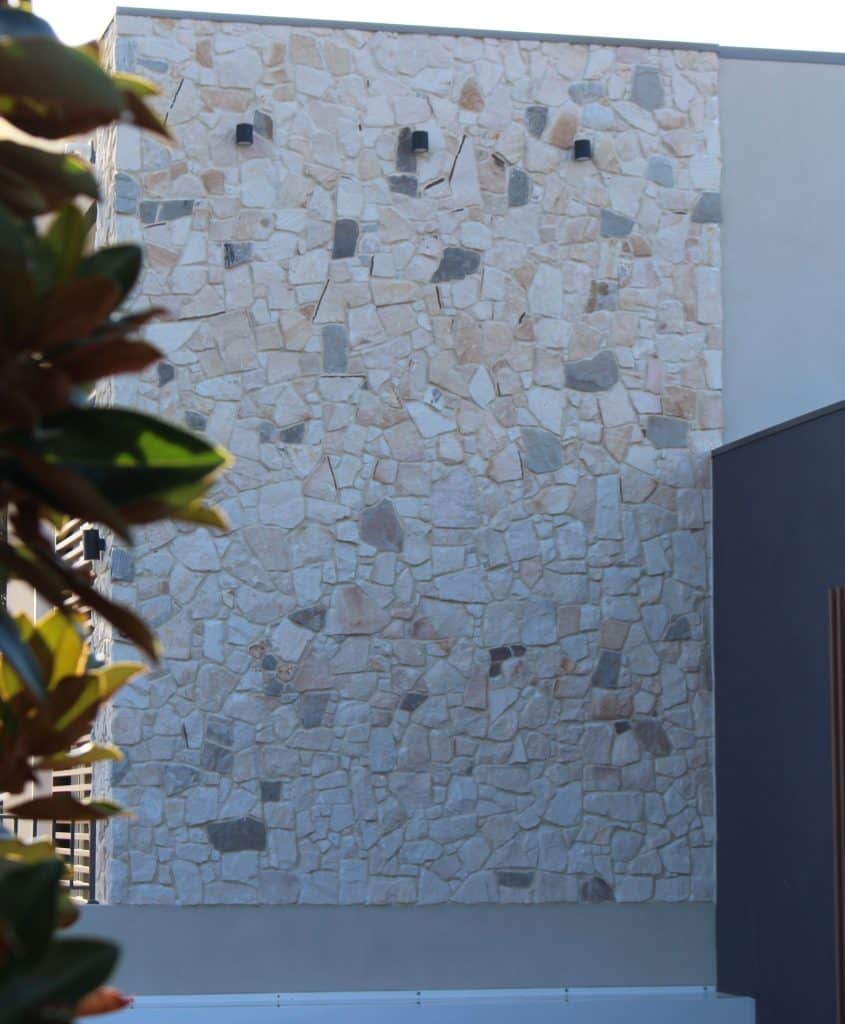
Open Joints Create More Natural Character
Slightly wider joints often create:
- softness,
- rhythm,
- shadow lines,
- and more traditional architectural depth.
This is particularly effective with:
- irregular walling,
- crazy paving,
- tumbled stone,
- cobblestones,
- and textured cladding.
Open joints allow the stone to breathe visually.
Rather than trying to hide the individuality of each piece, they celebrate it.
This often creates spaces that feel:
- more relaxed,
- more authentic,
- and more timeless.
European Architecture Has Always Embraced Jointing
Many of the world’s most admired stone buildings feature visible joints.
Traditional European stonework often incorporated:
- larger grout joints,
- irregular spacing,
- rough textures,
- and varied stone sizing.
These walls and floors feel rich because they contain:
- depth,
- imperfection,
- and visual movement.
Ironically, many modern projects attempt to remove these exact qualities in pursuit of “perfection.”
Yet contemporary architecture is increasingly rediscovering the beauty of natural irregularity.
Tight Joints Can Increase Installation Risk
From a technical perspective, extremely tight joints can sometimes create problems.
Buildings move.
Stone moves.
Temperature changes create expansion and contraction.
Without adequate movement allowance, pressure can build within the installation.
This may contribute to:
- cracking,
- tenting,
- grout failure,
- edge chipping,
- or delamination.
Grout joints are not simply decorative lines.
They help accommodate:
- tolerances,
- movement,
- and installation realities.
This becomes particularly important in:
- external paving,
- facades,
- pool surrounds,
- and large-format applications.
Open Joints Often Suit Natural Stone Better
Natural stone generally feels more comfortable with slightly relaxed spacing because it allows:
- variation to blend naturally,
- irregular edges to sit more comfortably,
- and textures to feel intentional rather than forced.
Open joints also tend to soften the overall appearance of the installation.
This is one reason why many architects now prefer slightly more natural jointing approaches rather than trying to achieve completely seamless layouts.
Different Stone Styles Suit Different Joint Widths
There is no universal “best” joint size. Different stones and architectural styles suit different approaches.
Tight joints often suit:
- large-format calibrated stone,
- minimalist architecture,
- honed finishes,
- contemporary interiors,
- and refined paving systems.
Open joints often suit:
- irregular walling,
- split-face cladding,
- cobblestones,
- antiquated limestone,
- crazy paving,
- and heavily textured materials.
The jointing style should complement the stone itself.
Shadow Lines Matter
One of the most overlooked aspects of jointing is shadow.
Slightly larger joints can create subtle shadow lines that introduce:
- depth,
- texture,
- movement,
- and architectural softness.
This becomes particularly powerful in natural light where stone surfaces shift throughout the day.
Ultra-tight joints can sometimes flatten this effect.
Architecture Is Moving Back Toward Authenticity
Many contemporary architects are shifting away from:
- sterile perfection,
- over-processed finishes,
- and artificial uniformity.
Instead, there is growing appreciation for:
- craftsmanship,
- texture,
- material honesty,
- and natural variation.
More relaxed stone jointing aligns perfectly with this movement.
It allows natural stone to feel like stone again.
So… Which Looks Better?
The truth is: neither tight nor open joints are automatically better.
The best result depends on:
- the architecture,
- the stone type,
- the texture,
- the scale,
- and the atmosphere being created.
But in our experience at AUSSIETURE.com.au, some of the most timeless and sophisticated stone projects are not the ones chasing absolute perfection.
They are the ones that embrace:
- texture,
- variation,
- movement,
- and the natural beauty of stone itself.
Because sometimes architecture becomes more refined when it stops trying to make natural materials look manufactured.


OUR RANGE →


